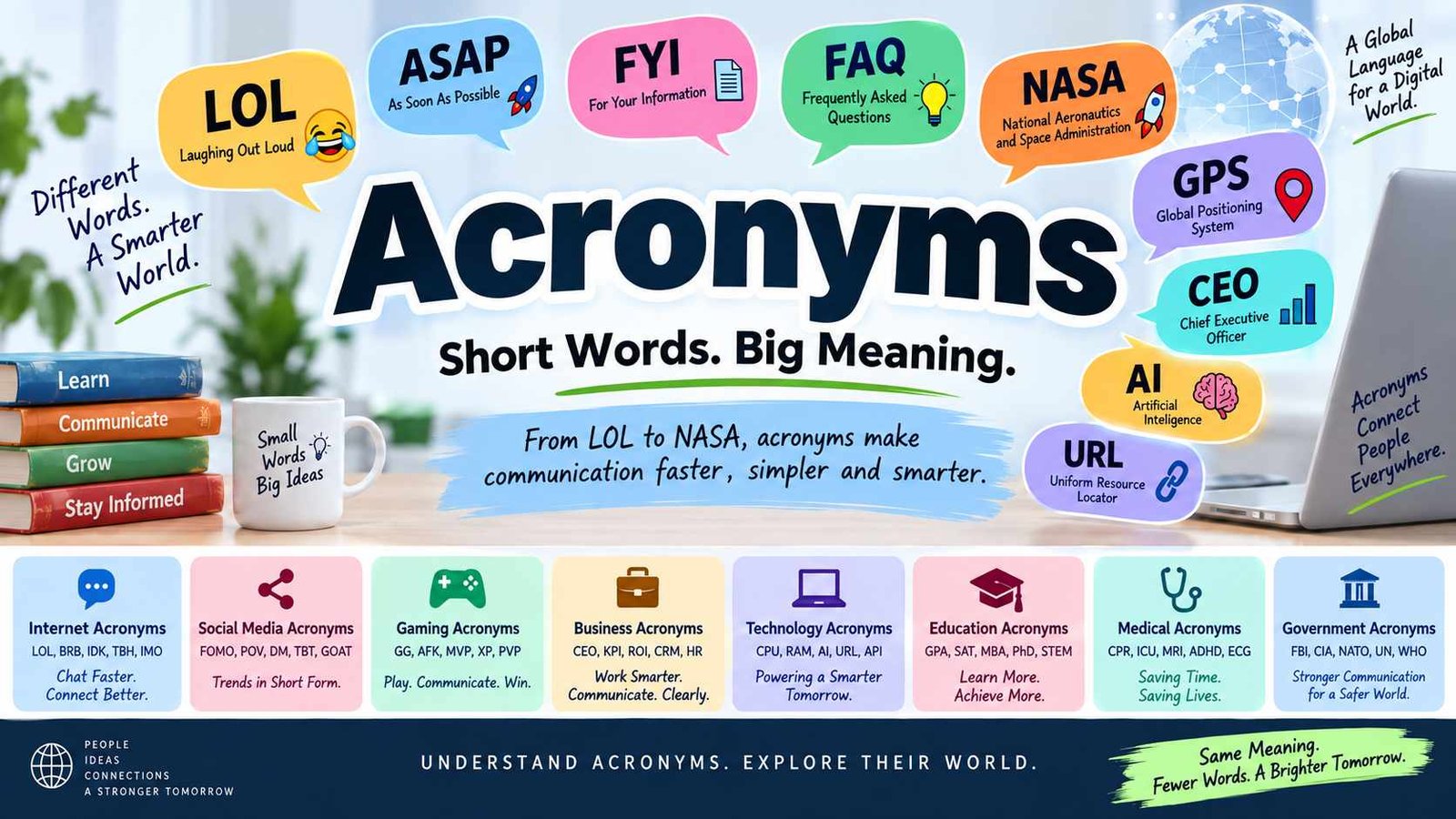
Have you ever received a message that said “LOL,” “BRB,” or “FYI” and instantly understood what it meant? If so, you’ve already used acronyms without even thinking about it.
Acronyms are everywhere. They appear in text messages, social media posts, business emails, school assignments, online gaming, healthcare, technology, and everyday conversations. In today’s fast-paced world, acronyms help people communicate complex ideas quickly and efficiently.
From internet slang and workplace communication to government agencies and scientific organizations, acronyms have become an essential part of modern language. They save time, reduce repetition, and make communication more convenient.
In this complete guide, you’ll learn what acronyms are, how they work, why they are important, and where they are commonly used.
Table of Contents
What Are Acronyms?
An acronym is a shortened form of a phrase created by using the first letters of multiple words.
For example:
- NASA = National Aeronautics and Space Administration
- LOL = Laughing Out Loud
- UNESCO = United Nations Educational, Scientific and Cultural Organization
- ASAP = As Soon As Possible
Instead of writing a long phrase repeatedly, people use acronyms to make communication faster and easier.
Simple Definition of Acronyms
An acronym is a word formed from the initial letters of a group of words and used as a shorter version of the original phrase.
Many acronyms eventually become so common that people recognize them more easily than their full forms.
For example, most people know “NASA” but may not immediately remember its complete name.
Quick Facts About Acronyms
| Feature | Description |
|---|---|
| Meaning | A shortened form made from initial letters |
| Purpose | Faster communication |
| Common Usage | Internet, business, education, healthcare, technology |
| Popular Examples | LOL, NASA, ASAP, UNESCO |
| Benefits | Saves time and improves efficiency |
| Origin | Ancient abbreviations evolved into modern acronyms |
How Do Acronyms Work?
Acronyms are created by taking the first letter of each major word in a phrase and combining them.
Example 1
Original Phrase:
Laughing Out Loud
Acronym:
LOL
Example 2
Original Phrase:
Be Right Back
Acronym:
BRB
Example 3
Original Phrase:
For Your Information
Acronym:
FYI
This simple method allows people to communicate the same idea using far fewer characters.
Why Are Acronyms Important?
Acronyms have become important because modern communication often requires speed and efficiency.
Whether you’re sending a text message, writing a business report, or participating in an online discussion, acronyms help reduce the amount of typing required.
Faster Communication
One of the biggest advantages of acronyms is speed.
Instead of typing:
“Please respond as soon as possible.”
People simply write:
“Please respond ASAP.”
The meaning remains clear while requiring fewer words.
Better Efficiency
Businesses, schools, government organizations, and online communities use acronyms to simplify communication.
Imagine repeatedly writing:
“Search Engine Optimization”
instead of simply using:
“SEO”
The acronym saves time and space.
Easier Memory
People often remember short acronyms more easily than long names.
Examples include:
- NASA
- FIFA
- UNESCO
- NATO
Many people recognize these acronyms immediately.
Universal Communication
Some acronyms are understood worldwide regardless of language or location.
Terms such as:
- FAQ
- VIP
- DIY
- GPS
have become globally recognized.
History of Acronyms
Although many people associate acronyms with the internet, they have existed for centuries.
Ancient Civilizations
Early forms of abbreviations appeared in ancient Greece and Rome.
Writers often shortened frequently used words to save writing space on stone tablets and manuscripts.
Military Influence
Acronyms became especially common during military operations.
Large organizations needed quick ways to communicate lengthy names and procedures.
Examples include:
- RADAR
- SONAR
- NATO
Many military acronyms later entered everyday language.
Government and Organizations
Governments and international organizations adopted acronyms to simplify official communication.
Examples include:
- FBI
- CIA
- WHO
- UNESCO
- NATO
These acronyms became widely recognized around the world.
Rise of Technology
As technology advanced, acronyms became even more common.
Computers, software, and technical industries introduced countless new acronyms.
Examples:
- CPU
- RAM
- USB
- HTML
- URL
Today, most internet users encounter these terms daily.
Internet and Social Media Era
The growth of online communication transformed acronyms into an everyday language.
Popular internet acronyms include:
- LOL
- BRB
- IDK
- TBH
- IMO
- AFK
Social media platforms accelerated their adoption among younger generations.
Acronyms vs Abbreviations
Many people mistakenly believe acronyms and abbreviations are the same thing.
While they are related, they are not identical.
What Is an Abbreviation?
An abbreviation is any shortened form of a word or phrase.
Examples:
- Dr. = Doctor
- Ave. = Avenue
- Info = Information
- App = Application
What Is an Acronym?
An acronym is specifically formed using the first letters of multiple words.
Examples:
- LOL
- NASA
- UNESCO
- NATO
Acronyms vs Abbreviations Comparison Table
| Feature | Acronyms | Abbreviations |
|---|---|---|
| Formed From | Initial letters of multiple words | Shortened words or phrases |
| Example | LOL | Info |
| Example | NASA | App |
| Example | UNESCO | Dr. |
| Usage | Organizations, internet, business | Everyday writing |
In simple terms, all acronyms are a type of abbreviation, but not all abbreviations are acronyms.
Types of Acronyms
Acronyms can be grouped into several categories depending on where they are used.
Internet Acronyms
Used in online communication.
Examples:
- LOL
- BRB
- IDK
- TBH
- NGL
Business Acronyms
Used in workplaces and professional environments.
Examples:
- CEO
- KPI
- ROI
- CRM
- HR
Technology Acronyms
Used in computers and technology.
Examples:
- CPU
- RAM
- URL
- HTML
- USB
Educational Acronyms
Used in schools, colleges, and universities.
Examples:
- GPA
- SAT
- MBA
- PhD
- STEM
Medical Acronyms
Used in healthcare and medicine.
Examples:
- CPR
- ICU
- MRI
- ADHD
- HIV
Government Acronyms
Used by public institutions and agencies.
Examples:
- FBI
- CIA
- IRS
- WHO
- NATO
Characteristics of Effective Acronyms
Not all acronyms become successful.
The most effective acronyms usually share several characteristics.
Easy to Remember
Short and memorable acronyms are more likely to be adopted.
Examples:
- NASA
- FIFA
- VIP
Easy to Pronounce
Some acronyms become popular because they can be spoken as words.
Examples:
- NASA
- UNESCO
- NATO
Relevant to Their Meaning
Good acronyms often reflect the purpose of the organization or phrase they represent.
Widely Recognized
The more frequently an acronym is used, the more recognizable it becomes.
This is why acronyms such as SEO, FAQ, GPS, and Wi-Fi are understood by millions of people worldwide.
Most Popular Acronyms in Everyday Life
Some acronyms have become so common that people use them without thinking about their original meaning.
| Acronym | Full Form |
|---|---|
| ASAP | As Soon As Possible |
| DIY | Do It Yourself |
| FAQ | Frequently Asked Questions |
| VIP | Very Important Person |
| GPS | Global Positioning System |
| Wi-Fi | Wireless Fidelity |
| CEO | Chief Executive Officer |
| MBA | Master of Business Administration |
| FBI | Federal Bureau of Investigation |
| NATO | North Atlantic Treaty Organization |
These acronyms appear regularly in business, education, technology, media, and everyday conversations.
Internet Acronyms
The rise of the internet transformed acronyms from organizational shortcuts into an everyday language used by millions of people. Whether you’re browsing social media, chatting with friends, participating in online forums, or sending text messages, internet acronyms help make communication faster and more efficient.
Internet acronyms became especially popular because early online platforms often had character limits and slower typing speeds. Over time, these shortcuts evolved into a universal language understood by internet users worldwide.
Popular Internet Acronyms
| Acronym | Full Form | Meaning |
|---|---|---|
| LOL | Laughing Out Loud | Something is funny |
| BRB | Be Right Back | Temporarily leaving |
| IDK | I Don’t Know | Uncertainty |
| TBH | To Be Honest | Honest opinion |
| IMO | In My Opinion | Personal viewpoint |
| IMHO | In My Humble Opinion | Respectful opinion |
| AFK | Away From Keyboard | Temporarily unavailable |
| NGL | Not Gonna Lie | Honest statement |
| SMH | Shaking My Head | Disappointment |
| IYKYK | If You Know, You Know | Shared understanding |
These internet acronyms continue to dominate online conversations across multiple platforms.
Social Media Acronyms
Social media has created an entirely new ecosystem of acronyms. Platforms such as TikTok, Instagram, Snapchat, Facebook, Reddit, and X encourage short, fast-moving conversations where acronyms thrive.
Why Social Media Uses Acronyms
Social media users prefer content that is:
- Fast to read
- Easy to understand
- Engaging
- Mobile-friendly
Acronyms help achieve all of these goals.
Common Social Media Acronyms
| Acronym | Full Form |
|---|---|
| FOMO | Fear Of Missing Out |
| POV | Point Of View |
| DM | Direct Message |
| TBT | Throwback Thursday |
| FYP | For You Page |
| OOTD | Outfit Of The Day |
| AMA | Ask Me Anything |
| ICYMI | In Case You Missed It |
| NSFW | Not Safe For Work |
| GOAT | Greatest Of All Time |
Many of these acronyms have become part of mainstream culture.
Text Messaging Acronyms
Text messaging played a major role in popularizing acronyms.
Before smartphones became common, SMS messages often had character limits. As a result, users developed shorter ways to communicate.
Common Texting Acronyms
| Acronym | Full Form |
|---|---|
| TTYL | Talk To You Later |
| LMK | Let Me Know |
| OMW | On My Way |
| BFF | Best Friends Forever |
| GTG | Got To Go |
| JK | Just Kidding |
| TY | Thank You |
| NP | No Problem |
| CU | See You |
| HAND | Have A Nice Day |
These acronyms remain widely used even today.
Gaming Acronyms
Gaming communities have developed their own extensive collection of acronyms.
Online multiplayer games require fast communication, making acronyms extremely useful.
Common Gaming Acronyms
| Acronym | Full Form |
|---|---|
| GG | Good Game |
| GLHF | Good Luck, Have Fun |
| AFK | Away From Keyboard |
| MVP | Most Valuable Player |
| DPS | Damage Per Second |
| HP | Health Points |
| XP | Experience Points |
| RNG | Random Number Generator |
| PVP | Player Versus Player |
| PVE | Player Versus Environment |
Gamers often rely on these terms during competitive matches.
Business Acronyms
Business professionals use acronyms daily to simplify workplace communication.
Without acronyms, many reports, emails, and meetings would become unnecessarily lengthy.
Common Business Acronyms
| Acronym | Full Form |
|---|---|
| CEO | Chief Executive Officer |
| CFO | Chief Financial Officer |
| KPI | Key Performance Indicator |
| ROI | Return On Investment |
| CRM | Customer Relationship Management |
| HR | Human Resources |
| B2B | Business To Business |
| B2C | Business To Consumer |
| EOD | End Of Day |
| ETA | Estimated Time Of Arrival |
Business acronyms help improve communication efficiency within organizations.
Technology Acronyms
Technology is one of the largest sources of modern acronyms.
Most computer users encounter dozens of technology acronyms every day.
Common Technology Acronyms
| Acronym | Full Form |
|---|---|
| CPU | Central Processing Unit |
| RAM | Random Access Memory |
| USB | Universal Serial Bus |
| URL | Uniform Resource Locator |
| HTML | HyperText Markup Language |
| CSS | Cascading Style Sheets |
| HTTP | HyperText Transfer Protocol |
| VPN | Virtual Private Network |
| API | Application Programming Interface |
| AI | Artificial Intelligence |
These terms are essential in today’s digital world.
Education Acronyms
Schools, colleges, and universities also rely heavily on acronyms.
Common Education Acronyms
| Acronym | Full Form |
|---|---|
| GPA | Grade Point Average |
| SAT | Scholastic Assessment Test |
| ACT | American College Testing |
| MBA | Master of Business Administration |
| PhD | Doctor of Philosophy |
| STEM | Science, Technology, Engineering, Mathematics |
| ESL | English as a Second Language |
| PTA | Parent Teacher Association |
| GPA | Grade Point Average |
| MOOC | Massive Open Online Course |
Educational institutions frequently use these acronyms in academic communication.
Medical Acronyms
Healthcare professionals often use acronyms to improve efficiency and reduce documentation time.
Common Medical Acronyms
| Acronym | Full Form |
|---|---|
| CPR | Cardiopulmonary Resuscitation |
| ICU | Intensive Care Unit |
| MRI | Magnetic Resonance Imaging |
| ADHD | Attention Deficit Hyperactivity Disorder |
| HIV | Human Immunodeficiency Virus |
| ECG | Electrocardiogram |
| BP | Blood Pressure |
| ENT | Ear, Nose, and Throat |
| ER |
Benefits of Using Acronyms
Acronyms have remained popular for decades because they make communication easier in many situations. From personal conversations to professional environments, acronyms help people exchange information quickly and efficiently.
Save Time
One of the biggest advantages of acronyms is speed. Instead of typing long phrases repeatedly, users can communicate the same message using just a few letters.
For example:
- ASAP instead of “As Soon As Possible”
- FYI instead of “For Your Information”
- LOL instead of “Laughing Out Loud”
This is especially useful in text messages, emails, and online chats.
Improve Communication Efficiency
Businesses, schools, healthcare organizations, and government agencies often use acronyms to streamline communication.
Imagine reading a report that repeatedly uses the phrase “Customer Relationship Management” instead of simply writing “CRM.” Acronyms make documents shorter and easier to read.
Reduce Repetition
Long phrases can become repetitive. Acronyms allow writers and speakers to avoid repeating the same terms over and over again.
Enhance Digital Communication
Modern communication often takes place on smartphones, social media platforms, and messaging apps. Acronyms fit perfectly into these environments because they require fewer characters and less typing.
Easy to Remember
Many acronyms become memorable because they are short and simple.
Examples include:
- NASA
- FIFA
- NATO
- UNESCO
- GPS
In many cases, people recognize the acronym more easily than the full phrase.
Drawbacks of Acronyms
Although acronyms offer many benefits, they can also create challenges.
Confusion for New Users
Not everyone understands every acronym.
A newcomer may struggle to understand messages filled with terms such as:
- IMO
- NGL
- IYKYK
- FOMO
Without context, these terms can be confusing.
Multiple Meanings
Some acronyms have more than one meaning.
For example:
CEO
- Chief Executive Officer
ETA
- Estimated Time of Arrival
- Edited To Add (online discussions)
The intended meaning often depends on the context.
Overuse Can Reduce Clarity
Using too many acronyms in a single conversation or document can make communication difficult to understand.
Professional writers often introduce the full term first before using its acronym.
Not Suitable for Every Situation
Acronyms work best in casual or specialized communication. However, they may not always be appropriate in formal writing, legal documents, or communication with unfamiliar audiences.
Most Commonly Misunderstood Acronyms
Some acronyms are frequently misunderstood because their meanings vary depending on where they are used.
LOL
Most people know LOL means “Laughing Out Loud.”
However, some older internet users originally interpreted it differently, leading to occasional misunderstandings.
AFK
AFK means “Away From Keyboard.”
Many people now use it even when they are using smartphones and not actual keyboards.
ETA
ETA traditionally means “Estimated Time of Arrival.”
Online, it can also mean “Edited To Add.”
OP
In gaming, OP usually means “Overpowered.”
On internet forums, OP often means “Original Poster.”
DM
DM commonly means “Direct Message.”
In tabletop gaming communities, it may also refer to a “Dungeon Master.”
Acronyms in Modern Culture
Acronyms are no longer limited to business reports or internet chats. They have become part of everyday culture.
Social Media
Platforms such as TikTok, Instagram, Reddit, Snapchat, and X rely heavily on acronyms.
Entertainment
Movies, television shows, podcasts, and online creators frequently use acronyms to connect with younger audiences.
Technology
The technology industry constantly introduces new acronyms.
Examples include:
- AI
- VR
- AR
- API
- SaaS
Education
Students encounter acronyms throughout their academic journey.
Examples include:
- GPA
- SAT
- ACT
- STEM
- MBA
As a result, acronyms have become deeply integrated into modern life.
The Future of Acronyms
As communication continues to evolve, acronyms will remain an important part of language.
Growth of Digital Communication
More communication takes place online than ever before. This naturally encourages the creation of new acronyms.
Artificial Intelligence and Technology
Emerging technologies continue to generate new terms and abbreviations.
Examples include:
- AI (Artificial Intelligence)
- LLM (Large Language Model)
- NLP (Natural Language Processing)
- ML (Machine Learning)
These terms are becoming increasingly common.
Global Communication
The internet allows people from different countries and cultures to interact instantly. Acronyms help create a shared vocabulary that can be understood across borders.
New Social Media Trends
Each new platform tends to generate its own language and terminology.
Future social networks will likely introduce additional acronyms that become part of everyday communication.
Frequently Asked Questions
What are acronyms?
Acronyms are shortened forms of phrases created using the first letters of multiple words.
Why are acronyms used?
They save time, improve efficiency, and make communication easier.
What is the difference between an acronym and an abbreviation?
An acronym is formed from the initial letters of a phrase, while an abbreviation is any shortened form of a word or phrase.
Are all abbreviations acronyms?
No. While all acronyms are abbreviations, not all abbreviations are acronyms.
What are some common internet acronyms?
Popular examples include LOL, BRB, IDK, TBH, AFK, and IMO.
What does LOL stand for?
LOL stands for “Laughing Out Loud.”
What does ASAP mean?
ASAP means “As Soon As Possible.”
What does FYI mean?
FYI stands for “For Your Information.”
What does FAQ mean?
FAQ stands for “Frequently Asked Questions.”
Why are acronyms popular on social media?
They make communication faster and fit well within short-form content.
Are acronyms used in business?
Yes. Businesses use acronyms such as CEO, KPI, ROI, CRM, and HR daily.
Are acronyms used in healthcare?
Yes. Medical professionals use acronyms such as CPR, ICU, MRI, and ADHD.
Can acronyms have multiple meanings?
Yes. Some acronyms have different meanings depending on the context.
Are acronyms becoming more common?
Yes. Digital communication continues to increase the use of acronyms worldwide.
Will acronyms continue to evolve?
Absolutely. New technologies, industries, and online communities regularly create new acronyms.
Final Thoughts
Acronyms have become one of the most effective tools for modern communication. They simplify complex phrases, save time, improve efficiency, and help people communicate more effectively across industries and platforms.
From internet slang and social media conversations to business meetings, healthcare systems, government organizations, and educational institutions, acronyms play a vital role in everyday communication.
Understanding acronyms is more important than ever because digital communication continues to grow. Whether you’re reading an online article, sending a text message, participating in a business discussion, or exploring new technologies, you’ll encounter acronyms everywhere.
As language evolves and technology advances, new acronyms will continue to emerge. Learning their meanings can help you stay informed, communicate more clearly, and better understand the modern world.